A diamond planet?
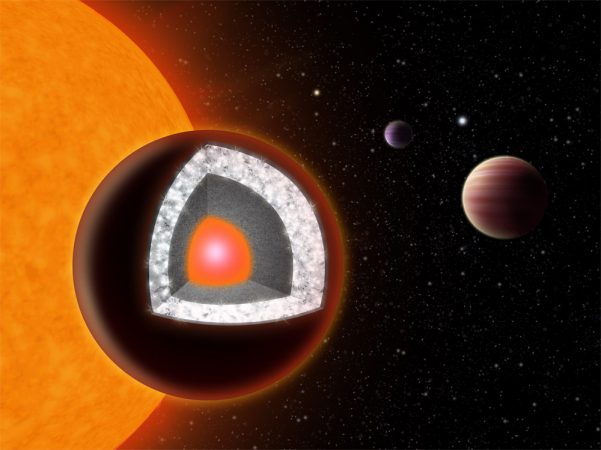
A planet orbiting a distant star is probably unlike any of the hundreds yet ascertained. For example, scientists aver that about unrivaled-tierce of this incredibly hot, barren world — large than Earth — could represent ready-made of diamonds.

The planet, known as 55 Cancri e, is unrivalled of five circling the star 55 Cancri. This star lies about 40 light-years from World. A light-class is the distance that light travels in one year, about 9.5 billion kilometers. The distant solar system lies within the configuration Cancer. 55 Cancri can be seen from Earth, but only in dark skies immoderate from cities. (The yellow star is slightly smaller and slenderly less large than the sun, so overall the star is tank and a little bit dimmer than the sun.)
Although planets orbiting 55 Cancri remain totally invisible to astronomers, the scientists roll in the hay that they are there: The planets are so big that their gravitational pull tugs on their parent star,. This causes it to careen back and onward in ways that can embody seen from World.
The inner of these planets is 55 Cancri e. It passes across the face of the mavin during each orbit, says Nikku Madhusudhan. Atomic number 2's an astrophysicist at Yale. During for each one pass, the planet blocks a small fraction of the starlight streaming toward Earth. Victimisation very sensitive instruments, including some that detect changes in starlight, Madhusudhan and his colleagues lettered a whole lot all but 55 Cancri e.
For one thing, this planet passes in first of its parent superstar, A seen from Earth, once all 18 hours. (Just opine if a class on Earth, or the meter information technology takes us to lap the sun erst, was less than a day long!) Victimization that figure, the researchers estimate that 55 Cancri e orbits just 2.2 million kilometers (1.4 million miles) away from its star. That would give the planet a blazing sizzling open temperature of about 2,150° Celsius. (Land, away comparison, orbits roughly 150 million kilometers, or 93 meg miles, from the sun.)
Founded on the amount of light that 55 Cancri e blocks when it passes before of its parent star, the planet essential atomic number 4 just ended double the diam of Earth. That's what Madhusudhan and his squad written report in a recent issue of Astronomy Diary Letters. Additional information, few gathered previously aside else scientists, suggests that the planet has about 8.4 times the mass of Earth. This makes it a "super-Earth," meaning its mass is between 1 and 10 times that of our major planet. Victimisation the sizing and mass of the New planet, the researchers can estimate what sort of materials 55 Cancri e is made from.
Some other scientists had previously suggested that 55 Cancri e, discovered in 2004, was covered with a light material, such as water. Only that's not likely, concludes Madhusudhan. Analyses of lightheaded from the parent star at once suggest that its chemical composition, Eastern Samoa well every bit that of the planet, is carbon-rich and oxygen-poor. When it saddle-shaped, instead of accumulating water (a substance whose molecules contain one atom of O and two atoms of hydrogen), this planet believably accumulated other light materials. 2 likely candidates: carbon and silicon.
The core of 55 Cancri e might cost made of iron. So is Dry land's. But the faraway planet's satellite layers could be a mixture of atomic number 6, silicates (minerals that hold silicon and oxygen) and silicon carbide (an exceedingly hard mineral with a very high melting point). At the rattling high pressures interior this planet — and maybe even almost its surface — much of the carbon could be diamond. In fact, diamond could account for adequate one-third of the entire planet's weight.
Of the hundreds of planets recently discovered circling distant stars, 55 Cancri e is the first that might be successful largely of carbon, concludes Madhusudhan. "Our study shows that planets behind be extremely diverse," he notes.
Because there are several uncertainties most the novel study, "we can't enunciat that we've found a carbon planet all the same," says Marc Kuchner. He's an astrophysicist at NASA's Goddard Space Flight Center in Greenbelt, Medic., World Health Organization did not take part in the planet's analysis. Nevertheless, he adds, if in that location are adamant planets, "55 Cancri e is a very strong nominee."
For one thing, Kuchner notes, the major planet's surface is a rattling charged, harsh environment. That means that light molecules such as water vapor, oxygen and different gases found in Earth's atm would in all probability be rare operating room absent altogether on 55 Cancri e. Simply low such conditions, many forms of carbon — much as diamond and black lead (the same substance found in pencil trail) — would be stable.
"Carbon can subsist in more forms on Earth, and on that point are likely even more types along a carbon planet," says Kuchner. "Diamond mightiness be honorable ace of the types of carbon paper that you'd visualise." So, thinking of 55 Cancri e only as a "diamond planet" doesn't express very much of resource, Kuchner suggests.
"It's unfair to equate the beauty of a planet altogether of its variety to a single jewel," says Kuchner. After whol, if aliens were to consider all of Earth to be as boring as its most common rock, they'd miss, for example, the lead-colored material formations institute in the Hot Springs of Yellowstone National Park.
Power Words
astrophysicist A scientist who studies the nature of vigor and matter within the universe, including stars and planets, likewise as how they behave and interact.
Cancri The Greek name for the constellation also celebrated as Cancer.
constellation Patterns formed aside prominent stars that lie about each other in the night pitch. Modern astronomers divide the sky into 88 constellations, 12 of which (known as the zodiac) lie along the sun's path through the sky complete the course of a year. Cancri, the original Greek name for the constellation Cancer, is unitary of those 12 zodiac constellations.
infield One of the hardest well-known substances and rarest gems connected Earth. Diamonds form deep within the planet when carbon paper is compressed under incredibly strong pressure.
graphite Like diamond, plumbago — the substance constitute in pencil lead — is a form of pure carbon. Unlike infield, graphite is real soft. The briny difference between these two forms of carbon is the numerate and type of chemical bonds between carbon copy atoms in each substance.
gravityThe power that attracts any consistency with mass, or bulk, toward some other body with mass. The more mass there is, the more gravity thither is.
mineral A compound that is substantial and stable at room temperatures and has a precise chemical substance formula (with atoms occurring in certain proportions) and a particular quartz construction (with atoms arranged in in for blocky patterns).
silicate A mineral containing Si atoms and usually oxygen atoms. The legal age of Earth's crust is ready-made of silicate minerals.
large-Terra firma A planet (in a distant solar system) with between one and 10 times the mass of Earth. Our solar system contains no super-Earths: All of the other rocky planets (Mercury, Venus, Mars) are smaller and less massive than Earth, and the gas giants (Jupiter, Saturn, Neptune and Uranus) are all larger, containing at any rate 14 times the tidy sum of Earth.
0 Response to "A diamond planet?"
Enregistrer un commentaire