German language supermodel Claudia Schiffer showing the piercing in her right earlobe.
Ear piercing is the well-nigh popular form of body piercing. It usually involves making a hole through the earlobe, into which information technology is and so possible to insert an earring. The holes may exist permanent or temporary. The holes become permanent when a fistula is created by scar tissue forming around the initial earring. If the earring is removed before the fistula has formed, the piercing will close and heal up again, leaving no trace on the surface of the earlobe to show it had ever been pierced. Once the piercing has fully healed, the earlobe tin can and so be re-pierced in the aforementioned spot at a later fourth dimension if desired.
Common locations for piercings, other than the earlobe, include the rook, tragus, and across the helix. The uncomplicated term "ear piercing" commonly refers to an earlobe piercing, whereas piercings in the upper part of the external ear are oft referred to equally "cartilage piercings". Cartilage piercings are more complex to perform than earlobe piercings and have longer to heal.
History
Ear piercing has been practised all over the earth since ancient times, particularly in tribal cultures. There is considerable written and archaeological evidence of the do. Mummified bodies with pierced ears have been discovered, including the oldest mummified body discovered to date, the v,300 yr-erstwhile Ötzi the Iceman, which was establish in a Valentina Trujillonglacier in Austria.[1] This mummy had an ear piercing 7–11 mm (1 to 000 gauge in American wire gauge) bore.[1] The oldest earrings institute in a grave date to 2500 BCE. These were located in the Sumerian city of Ur, abode of the BiblicalpatriarchAbraham.[2] Earrings are mentioned in the Bible. In Genesis 35:four, Jacob buries the earrings worn by members of his household forth with their idols. In Exodus 32, Aaron makes the golden calf from melted earrings. Deuteronomy 15:12–17 dictates ear piercing for a slave who chooses not to be freed.[3] Earrings are also referenced in connexion to the Hindu goddess Lakshmi in the Vedas.[4] Earrings for pierced ears were found in a grave in the Ukok region between Russia and Communist china dated betwixt 400 and 300 BCE.[5]
Among the Tlingit of the Pacific Northwest of America, earrings were a sign of nobility and wealth, as the placement of each earring on a kid had to exist purchased at an expensive potlatch.[six] Earrings were common in the Eighteenth dynasty of Egypt (1550–1292 BCE), mostly taking the form of a dangling, aureate hoop.[vii] Gem-studded, golden earrings shaped similar asps seem to take been reserved for nobility.[8] The ancient Greeks wore paste pendant earrings shaped like sacred birds or demigods, while the women of ancient Rome wore precious gemstones in their ears.[9]
In Europe, earrings for women fell from fashion more often than not between the 4th and 16th centuries, as styles in clothing and hair tended to obscure the ears, but they gradually thereafter came back into vogue in Italy, Spain, England and France, spreading every bit well to N America.[10][11][12] According to The Anatomie of Abuses past Philip Stubbs, earrings were fifty-fifty more common among men of the 16th century than women, while Raphael Holinshed in 1577 confirms the practice amidst "lusty courtiers" and "gentlemen of backbone."[thirteen] Patently originating in Spain, the practice of ear piercing amid European men spread to the court of Henry Iii of French republic and so to Elizabethan era England, where earrings (typically worn in ane ear simply) were sported by such notables as Robert Carr, 1st Earl of Somerset, Shakespeare, Sir Walter Raleigh and Charles I of England.[13] Common men wore earrings as well. From the European Middle Ages, a superstitious belief that piercing one ear improved long-distance vision led to the do among sailors and explorers.[14] Sailors also pierced their ears in the belief that their earrings could pay for a Christian burying if their bodies done up on shore.[15]
Recent history
In Europe and North America, ear piercing remained popular for women throughout Victorian times, only fell from favor in the early 1900s with the invention of screw-back earrings. Every bit these could exist worn without the demand to pierce the earlobes, ear piercing fell from favor, and by the 1920s was considered to exist something of a taboo in the upper echelons of society, and usually associated with maverick behaviour. This was later reinforced by the evolution in the 1930s of the much cheaper clip-on style of earrings, which allowed all levels of guild to beget large and bold styles of not-pierced earrings. As a result, by the 1940s, very few European or American women had pierced ears.
Interest in ear piercing amongst European and American women began to rise again in the early 1950s. Information technology began in the UK in 1951 when Princess Elizabeth (the future HM Queen Elizabeth Ii) had her ears pierced in early September 1951 especially to be able to habiliment a pair of pierced earrings she had been given as a gift.[16] When it was noticed that the Princess had pierced her ears, most women in the UK decided to follow her lead and also had their ears pierced. This then led many women in the residue of Europe and America to also have their ears pierced.[17] Nevertheless, after this brief upsurge in interest, ear piercing once more than brutal from favor in the late-1950s and was over again considered something of a taboo. Ear piercing then began to come dorsum into favor again in the late 1960s, partly through the Beatnick, Hippie and gay communities, and men one time once again began to pierce one ear although, at this time, male person ear piercing was still quite uncommon.
Ear Piercing - 1976 Australian TV Segment 'Flashez'
1976 Australian TV report on department store ear piercing event.
In the 1970s, interest in ear piercing amongst women began to increase dramatically following the invention of specialist ear piercing instruments, commonly referred to as "piercing guns". Prior to this, ear piercing was a painful procedure which was either performed at home, or commercially past a doctor, using a needle to pierce the earlobes. The invention of the "piercing gun", which used a sharpened starter earring to pierce the earlobe, greatly simplified the process and reduced the pain involved. This allowed ear piercing to be offered past jewellers, beauty salons and other establishments. Department stores would hold ear piercing events, sponsored by earring manufacturers, at which a nurse or other trained person would use one of the newly-developed "piercing guns" to pierce client's ears. Through the 1970s, ear piercing became increasingly popular, especially amidst teen-aged girls, who saw having their ears pierced every bit a rite of passage to womanhood. Older women chose to pierce their ears during this menstruum mainly considering they found wearing pierced earrings to be much more comfortable than wearing prune-ons, which tend to pinch the earlobe and cause pain after a short time. Among the celebrities who chose to pierce their ears for the first time during this menses included model and actress Twiggy, singers Karen Carpenter and Bonnie Tyler, and actresses Elizabeth Taylor and Farrah Fawcett. By the finish of the decade, the majority of Western women (over 90%), and about all teen-anile girls, had pierced ears, and beingness unpierced was considered unusual. During the mid-1970s, male ear piercing likewise increased in popularity, in part due to the Punk Rock move.
By the 1980s, the trend for male popular music performers to have pierced ears helped establish a mode trend for men. This was later adopted by many professional athletes. Some British men started piercing both ears in the 1980s; George Michael of Wham! was a prominent example. The heavily jeweled Mr. T was an early on case of an American glory wearing earrings in both ears. Amongst women, the 1980s saw the rise in multiple ear piercings, with many women choosing to vesture two or more than earrings in each earlobe.
In the 1990s, the fashion for multiple piercings led to a ascension in the popularity of piercing the cartilage of the ears. A variety of specialized cartilage piercings have since become pop. These include the tragus piercing, antitragus piercing, rook piercing, industrial piercing, helix piercing, orbital piercing, daith piercing, and conch piercing. In improver, earlobe stretching, while common in indigenous cultures for thousands of years, began to appear in Western society in the 1990s, and is now a fairly common sight. However, these forms of ear piercing are yet infrequent compared to standard ear piercing. The 1990s likewise saw a ascension in men piercing both ears. In the U.k., the trend for men to pierce both ears was popularised past footballer David Beckham, while in America it largely came from the Rap music community.
Today, the peachy bulk of Western women (effectually 95%) have pierced ears, and many men (around 40%) accept at to the lowest degree one ear piercing, making it by far the most popular blazon of piercing.
Ear piercing in popular culture
In the 1978 movie Grease (set in 1959), Sandy (Olivia Newton-John), the leading lady, has her ears pierced past her friends during a party. The piercing takes place off-photographic camera and is non seen being performed.
In Full House, the season six episode I'm Not D.J. features a scene where the character of Stephanie, played by Jody Sweetin, has her ears pierced past the character of Kimmy, played by Andrea Barber. The piercing was washed live on set using a jump-powered gun, and had to be captured in a single take every bit Jody actually was having her ears pierced.
The 1998 remake of the 1961 movie The Parent Trap includes a scene where the character of Annie, played by Lindsay Lohan, has her ears pierced past her identical twin sister Hallie (also played by Lohan). Prior to the get-go of filming, Lohan had her ears pierced for the first time particularly for the role. For the ear piercing scene, which was shot in close-upward, make-up was practical to her earlobes to hide her piercings, and her double, Erin Mackey, pushed a blunted sewing needle through her existing piercings to "pierce" her ears.
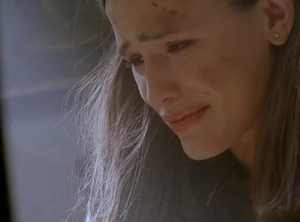
Jennifer Garner as Diane Agostini in Aftershock: Earthquake in New York.
For her office as Diane Agostini in the 1999 disaster motion-picture show Aftershock: Earthquake in New York, actress Jennifer Garner had her ears pierced peculiarly for the first time. After filming was completed, she then stopped wearing earrings and, as her ears had only been pierced for a short time, her piercings closed up again and healed completely. In 2006, she and then had them re-pierced to let her to wearable a pair of $250,000 Fred Leighton diamond chandelier earrings to that year's Academy Awards ceremony. Having again let her piercings heal up soon subsequently the awards ceremony, Jennifer so had her ears re-pierced a second fourth dimension in 2009, at the same time as her older sister Melissa Wylie had hers pierced for the first time, and has since connected to wear pierced earrings.
In the 1994 picture My Girl 2, set up in 1974, the lead character of Vada, played past Anna Chlumsky has her ears pierced part-way through the film. In the concluding cut of the motion picture, Vada is seen going into a shop that offers an ear piercing service, and the next scene shows her some fourth dimension later with newly-pierced ears. A scene was shot that showed Vada having her ears pierced past a shop assistant using a piercing gun, but this did not make it into the final cut. This deleted scene had to be captured in a unmarried have as Chlumsky, who did not have pierced ears, actually was being pierced for existent.
In the 2003 movie Freaky Friday, actress Jamie Lee Curtis is seen getting a new ear piercing using a piercing gun.
Claudia Schiffer models earrings for the Accessorize A/W 2006 entrada.
In May 2006, German language supermodel Claudia Schiffer agreed to take her ears pierced for the beginning time at the age of 35 especially for her photoshoot for the Autumn/Winter 2006 Accessorize advertising campaign. This was then that she would be able to model the earrings from that season'south range, all of which were made for pierced ears.
"When we were discussing the photoshoot details a few weeks beforehand, they asked me if I'd be prepared to have my ears pierced, as all of the new flavor'due south earrings were for pierced ears. I'd never had them done earlier but, equally they said they'd pay me an boosted fee if I agreed to have them pierced, I thought 'why not', and had them washed the very next day. At first, information technology felt a bit foreign to have them done, but I presently got used to it. Now, I really love them and keep wondering why I waited so long to have them washed."
On the 1987 BBC Children in Demand charity telethon, actress Bonnie Langford had her ears pierced alive on air after some of her friends promised to make a large donation if she agreed to accept her ears pierced for the get-go time.
For her 51st birthday, talk show host Oprah Winfrey had her ears pierced for the first time live on her show. The piercing was washed by a plastic surgeon using a piercing gun. Several months later, a "follow upwardly" show featured a number of other women who'd been inspired by Oprah also having their ears pierced live on the show.
In Baronial 1999, Italian actress Monica Bellucci had her ears pierced for the offset time at the age of 35 especially for her lead role in the movie Malena.
In the video for her unmarried "Heathen Poetry", Icelandic vocaliser Bjork pierces her own ear with a sewing needle and uses it to depict thread through the piercing.
Actress Greta Scacchi had her ears pierced especially for her part every bit Isabel in the movie Fires Within so that she would be able to clothing the big hoop earrings favored past many Cuban women.
Mischa Barton on the comprehend of issue 1 of Twelv magazine in 2012, wearing large diamond studs in her pierced ears.
In 2009, soon before first production on her new Television set show The Cute Life, actress Mischa Barton had her ears pierced for the first fourth dimension specially and so that her character in the testify, supermodel Sonja Stone, would be able to wear pierced earrings in the various fashion show and photoshoot scenes.
"When I signed upward for The Beautiful Life and we were discussing costumes for Sonja, they asked me if I'd be prepared to accept my ears pierced, so that Sonja will be able to wear the aforementioned earrings as all the other models in some of the fashion evidence scenes. And, as I'd already been thinking once again near perhaps getting them washed, I figured that maybe now was the fourth dimension, then I said 'OK' and got them washed a couple of days later. It definitely does notwithstanding experience a bit strange to accept them washed, and I'm nevertheless getting used to irresolute earrings - Information technology still feels really weird to exist pushing bits of metal through holes in my earlobes that weren't at that place a few weeks dorsum, and really seeing and feeling the holes in my lobes is still a bit freaky. Just I'm slowly getting used to having pierced ears, and I'chiliad glad I did get them done because I'1000 having loads of fun ownership and trying all unlike kinds of earrings."
In her 2010 TV documentary Ruddy Gets Pierced, in which she explores body-piercing culture, presenter Crimson Healey has her ears pierced for the commencement time at the historic period of 30. The piercing was done by a local jeweler using a hand-force per unit area piercing gun.
In the 1980s British Tv series Me and My Girl, the season i episode Jobs for the Girls featured a sub-plot in which the central character of Samantha, played by teen-anile actress Joanne Ridley, wanted to get her ears pierced, but was not allowed to by her father. This sub-plot was included considering Joanne had asked the producers if she could accept her ears pierced. They agreed and, a few minutes before the last scene was shot, in which Samantha reveals that she'south gone ahead and had her ears pierced, she had her ears pierced especially past the make-up artists.
In the Boob tube drama Dr Quinn, Medicine Woman, the season three episode Indian Agent includes a scene in which the regular character of Colleen, played by Erica Flores, has her ears pierced for her sixteenth birthday. The piercing was performed past atomic number 82 actress Jane Seymour using an antiquarian 19th Century ear-piercing device to maintain historical accurateness and, because Erica really was having her ears pierced for the first time, had to be captured in a single accept.
For her lead role as Lisbeth in the The states remake of The Girl with the Dragon Tattoo, extra Rooney Mara agreed, in addition to having a number of other piercings, to accept her ears pierced for the first time. She had her left earlobe pierced iii times, and her right earlobe pierced in one case.
Elle Fanning in the movie Teen Spirit.
Actress Elle Fanning besides agreed to have her ears pierced for the first time for her lead office in the 2022 movie Teen Spirit, having both ears pierced three times to wear multiple pairs of different-sized hoop earrings.
In 1954, at a time when ear piercing was relatively uncommon, actress Dorothy Dandridge had her ears pierced especially for her lead part in the movie Carmen Jones.
On the May 18th 2022 episode of Jimmy Kimmel Alive!, as part of her self-confessed mission to endeavor new experiences, actress Gillian Jacobs had her ears pierced for the very start time live on air.[eighteen]
Having let them heal up several years previously, actress Heather Graham had her ears re-pierced in order to clothing a pair of big gold hoop earrings for her part as Stevie in the 2022 Television drama Studio City, which was cancelled after the pilot episode had been filmed.
In early 2021, actress Kristen Stewart had her ears pierced for the first fourth dimension especially for her part as Princess Diana in the film Spencer. This was to let her to wearable accurate replicas of Diana's earrings, most of which were fabricated for pierced ears.
Religious and cultural influences
In Spain and many Latin American countries, it is usual for infant girls to accept their ears pierced soon after birth. Very often, the piercing is done by a infirmary nurse immediately after birth. As a outcome, almost all women in these countries accept pierced ears.
In India, well-nigh all the girls and some boys go their ears pierced in a religious ceremony before they are most 5 years quondam. Infants may go their ears pierced as early on every bit several days later their birth.
Similar community are practised in other Southeast Asian countries, including Nepal, Sri Lanka, and Laos, although traditionally most males expect to go their ears pierced until they have reached young adulthood. They only tend to permit one piercing on each ear as it is seen equally disrespectful to take any more than that.
In Japan in the early 1980s, women were non allowed to have their ears pierced until they reached the historic period of twenty.[19] Fifty-fifty today, many schools there do not allow girls to have pierced ears, meaning that many take to wait until they are xviii before they can pierce their ears.
In Democratic people's republic of korea, ear piercing is completely banned, as it is seen equally a sign of "Western decadence".
Piercing techniques
A variety of techniques are used to pierce ears, ranging from "do information technology yourself" methods using household items to medically sterile methods using specialized equipment.
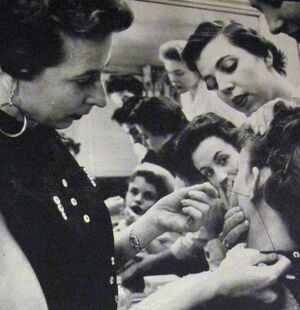
A moving-picture show from 1957 showing a young adult female having her ears pierced using a sewing needle and thread.
A long-standing home method involves using ice every bit a local anesthetic, a sewing needle as a puncture instrument, a burning match and rubbing alcohol for disinfection, and a semi-soft object, such as a white potato, cork, or rubber eraser, every bit a push point. Sewing thread may be fatigued through the piercing and tied, equally a device for keeping the piercing open during the healing process. The employ of thread cruel from favor as it oft attracted contamination that could cause infection of the piercing, sometimes then severe that it could cause death in the days before antibiotics.[20] Alternatively, a gold stud or wire earring may be directly inserted into the fresh piercing equally the initial retaining device. Home methods are oftentimes dangerous and risky due to issues of improper sterilization or placement, and needle piercings ordinarily involve a considerable caste of pain as the needle is slowly pushed through the earlobe. This method is also used past many professional body piercers to pierce ears, although they use a single-employ sterile needle in identify of the sewing needle, combined with forceps that are reused multiple times and have to exist sterilized in an autoclave between customers. If this sterilization is non carried out correctly, needle piercing can deport a considerable risk of disease transmission between customers due to blood-borne pathogens.
Another method for piercing ears, first made popular in the 1960s, was the apply of sharpened leap-loaded earrings known every bit cocky-piercers, trainers, or sleepers, which gradually pushed through the earlobe. However, these could slip from their initial placement position, often resulting in more discomfort, and many times would non go all the way through the earlobe without additional pressure level beingness practical. This method has fallen into decay due to the popularity of faster and more successful piercing techniques.
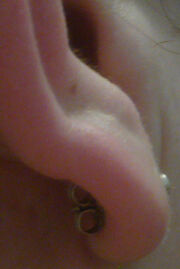
Pierced ear with traditional starter stud
Ear piercing instruments, sometimes called ear piercing guns, were originally adult for physician employ only with modifications became bachelor in retail settings.[21] These use either a potent spring or paw pressure to apace drive a sharpened starter earring through the earlobe, taking a fraction of a 2nd to create the piercing. Today, the smashing bulk of people in the Western globe accept their ears pierced with an ear piercing musical instrument in speciality jewellery or accessory stores, or at habitation using disposable ear piercing instruments. An earlobe piercing performed with an ear piercing instrument is often described every bit being completely painless, although some describe information technology as feeling similar to being pinched, or being snapped by a rubber ring. Piercing with this method, especially for cartilage piercings, is not recommended by many piercing professionals and physicians, equally information technology can shatter the ear cartilage and atomic number 82 to serious complications. Ear piercing instruments take the bang-up reward over needle piercings of beingness designed in such a manner that all parts which come into contact with the client are sterile dispensable unmarried-use components. This totally eliminates the possibility of cross-contagion between customers, and it is for this reason that most health government either recommend or specifically require the use of this type of instrument for ear piercing.
In tribal cultures and among some neo-archaic trunk piercing enthusiasts, the piercing is fabricated using other tools, such equally animate being or plant organics.
Initial healing time for an earlobe piercing performed with an ear piercing instrument is typically half-dozen weeks, during which time the fistula is gradually created past the scar tissue forming around the earring. If the earring is removed from the piercing before the finish of the initial healing time, the piercing volition before long close upwardly and the pare of the earlobe will heal, leaving no sign that the earlobe has ever been pierced. After the cease of the initial healing time, earrings can be changed, but if the hole is left unfilled for an extended flow of fourth dimension, there is some risk of the piercing endmost. Piercing professionals recommend wearing earrings in the newly pierced ears for at least half dozen months, and sometimes even a full year, during which time the tissue forming the fistula will thicken, making the piercing permanent. Cartilage piercing will normally crave more than healing fourth dimension than earlobe piercing, sometimes 2–3 times every bit long. Later on healing, earlobe piercings will shrink to smaller gauges in the prolonged absence of earrings. In many cases, if earrings are non worn for a prolonged period, the piercing will shrink to such an extent that information technology volition almost completely disappear, making it very hard to run into. It will, even so, remain open, and earrings can be reinserted into the piercing at any time up to several years after they have last been worn. Examples of celebrities who have pierced ears, but whose piercings tin can be very difficult to run across if they have not worn earrings for a while include Alicia Witt, Claudia Schiffer, Jennifer Garner and Mischa Barton.
Notes
↑ 1.01.1(Hesse 2007, p. xvii)
↑(Hesse 2007, p. 78)
↑(Ullman 2008)
↑Cite error: Invalid <ref> tag; no text was provided for refs named Affections
↑(Affections 2009, p. 12)
↑(Gay & Whittington 2002, p. 53)
↑(White 1970, p. 116)
↑(Wilkinson 1837, pp. 370–371)
↑(Wilkinson 1837, p. 79)
↑(Wilkinson 1837, pp. 79–80)
↑(Smith 1908, p. 233)
↑(Prisant 2003, p. 406)
↑ 13.013.ane(Smith 1908, pp. 234–235)
↑(Hesse 2007, p. 26)
↑Cite error: Invalid <ref> tag; no text was provided for refs named Angel3
↑Piercing of Imperial Ears May Start New Way, The Montreal Gazette, September 8 1951.
↑Best Bib and Tucker Put in Order By Those Attention Queen's Fetes; Gloves to Shoulder, New York Times, October 19 1957.
↑Terrified Gillian Jacobs Gets Her Ears Pierced on Kimmel
↑Port Alice Daughter Returns From Pupil Exchange North Island Gazette, September 2, 1981.
↑Poisoned by Silk in Her Ears, New York Times, May 11 1890.
↑Erica Weir (2001-03-20). "Canadian Medical Association Journal - Umbilicus gazing: a clinical glimpse at body piercing". Cmaj.ca. http://www.cmaj.ca/cgi/content/full/164/6/864. Retrieved 2012-06-10.
References
Angel, Elayne (2009). The Piercing Bible: The Definitive Guide to Safe Body Piercing. The Crossing Press. ISBN 1-58091-193-v. http://books.google.com/?id=uz-84gxdYAgC&printsec=frontcover&dq=isbn=ane-58091-193-5&cd=1#5=onepage&q=.
Gay, Kathlyn; Christine Whittington (2002). Body Marks: Tattooing, Piercing, and Scarification. Women at War. Twenty-First Century Books. ISBN 0-7613-2352-10.
Hesse, Rayner Due west. (2007). Jewelrymaking through History: an Encyclopedia. Handicrafts Through World History. Greenwood Publishing Group. ISBN 0-313-33507-9. http://books.google.com/books?id=IVgU0icm948C&printsec=frontcover&dq=isbn=0-313-33507-9&cd=1#v=onepage&q=&f=faux.
Prisant, Carol (18 January 2003). Antiques Roadshow Collectibles: the Complete Guide to Collecting 20th-century Toys, Glassware, Costume Jewelry, Memorabilia, Ceramics & More. Workman Publishing. ISBN 978-0-7611-2822-9.
Smith, Harold Clifford (1908). Davenport, C.. ed. Jewellery. Connoisseur's library. 16 (second ed.). Methuen and co..
Ullman, Yirmiyahu (xv March 2008). "Hoops on Studs". Ask the Rabbi. Ohr Somayach. http://ohr.edu/yhiy/article.php/3430. Retrieved 4 April 2010.
White, Jon Ewbank Manchip (1970). Ancient Egypt; Its Culture and History. Courier Dover Publications. ISBN 0-486-22548-eight.
Wilkinson, Sir John Gardner (1837). Manners and Customs of the Ancient Egyptians. three. J. Murray.





0 Response to "What Can Pierce One's Ear Without a Hole"
Enregistrer un commentaire