What Can Project Managers Do to Protect the Quality and Integrity of the Data Collection Process
If your visitor's data is altered or deleted, and you have no manner of knowing how, when and by whom, it can have a major touch on information-driven business decisions. This is why data integrity is essential. To empathize the importance of data integrity to a company's lesser line, permit us examine what it is, why it'south significant, and how to preserve it.
What is Data Integrity?
Data integrity refers to the reliability and trustworthiness of information throughout its lifecycle. It can describe the state of your data—eastward.g., valid or invalid—or the process of ensuring and preserving the validity and accuracy of data. Mistake checking and validation, for example, are common methods for ensuring data integrity every bit part of a process.
Want more than insight into data security trends? Download our in-depth data breach statistics report.
What is the Difference Between Data Integrity and Data Security?
Data integrity is non to be confused with data security. Data security refers to the protection of data, while data integrity refers to the trustworthiness of data.
Information security focuses on how to minimize the risk of leaking intellectual belongings, business organisation documents, healthcare data, emails, trade secrets, and more. Some data security tactics include permissions management, information classification, identity and access management, threat detection, and security analytics.
Why is it Important to Maintain Information Integrity?
Imagine making an extremely important business decision hinging on information that is entirely, or even partially, inaccurate. Organizations routinely make information-driven business organization decisions, and data without integrity, those decisions can take a dramatic consequence on the visitor's bottom line goals.
A new report from KPMG International reveals that a large majority of senior executives don't have a high level of trust in the fashion their organization uses data, analytics, or AI.
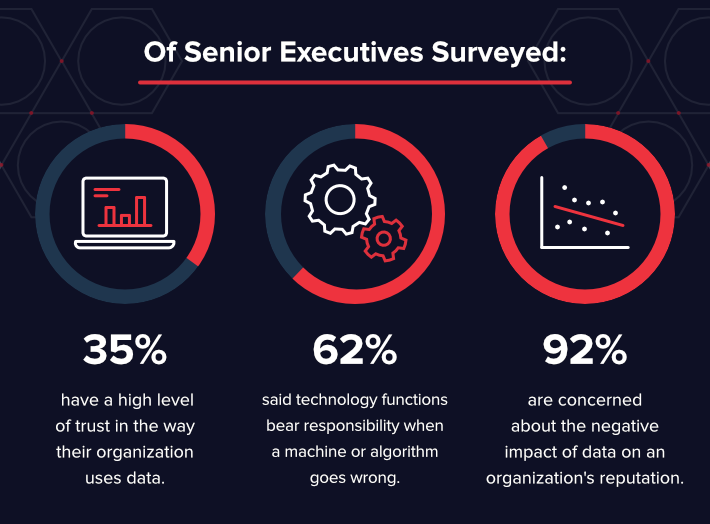
Only 35% say they have a high level of trust in the way their organization uses data and analytics. 92% are concerned about the negative impact of data and analytics on an organization'southward reputation. What'southward more, 62% of senior executives said engineering science functions, not the C-level and functional areas, conduct responsibility when a car or an algorithm goes incorrect.
Organizations need to go through the motions of preserving data integrity in society for C-level executives to make proper concern decisions.
Data Integrity Threats
Data integrity can be compromised through homo error or, worse yet, through malicious acts. Data that's accidentally altered during the transfer from i device to another, for example, can be compromised, or even destroyed by hackers.
Common threats that can alter the state of information integrity include:
- Human error
- Unintended transfer errors
- Misconfigurations and security errors
- Malware, insider threats, and cyberattacks
- Compromised hardware
Then how practise you know when your data has integrity? You have to look at the following features:
Retrievability and accessibility – It's important to have accurate data in the proper locations at the right fourth dimension when anyone is working on projections, a bargain, or presentation. Without proper and easy admission and retrieval, it can be detrimental to the business organisation, yielding the way for your competition to win.
Traceability –Today, you can trace every touchpoint yous make with a prospect or client. How? With a data bespeak. The data can inform decision makers, highlight red flags, deficiencies, or limitations. Make certain these touchpoints are accurate.
Reliability – Having reliable, consistent concern metrics against company goals and the competition is what will take an organisation to the top.
How to Preserve Information Integrity [Checklist]
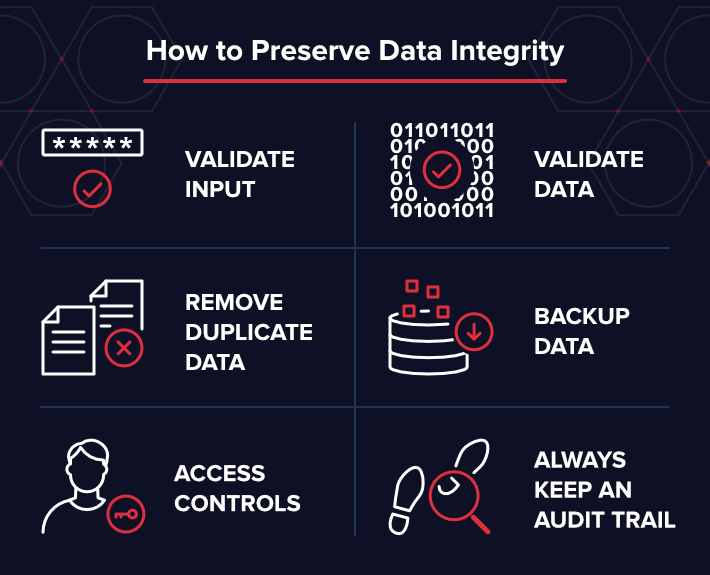
The data integrity threats listed above also highlight an aspect of data security that can help preserve data integrity. Apply the following checklist to preserve data integrity and minimize risk for your organization:
- Validate Input:When your data set is supplied by a known or unknown source (an cease-user, some other application, a malicious user, or any number of other sources) you should require input validation. That data should be verified and validated to ensure that the input is authentic.
- Validate Information: It'south critical to certify that your data processes oasis't been corrupted. Identify specifications and key attributes that are important to your organization earlier yous validate the data.
- Remove Duplicate Data: Sensitive data from a secure database tin can hands find a abode on a certificate, spreadsheet, email, or in shared folders where employees without proper admission tin can run into it. It'due south prudent to clean upwardly devious information and remove duplicates.
Smaller companies without a dedicated staff will notice that these tools can assist them clean upward duplicate files on a difficult drive or cloud.
- Clone Files Checker
- Duplicate Images Finder
- Easy Indistinguishable Finder
- Indistinguishable Cleaner
- CCleaner
- DoubleKiller
- WinMerge
For Windows Servers: Use the Data Deduplication feature to clean up cloned files. Too try the File Server Resource Director to remove devious files.
- Support Data: In addition to removing duplicates to ensure data security, information backups are a critical role of the process. Backing up is necessary and goes a long way to forbid permanent data loss. How ofttimes should you be backing upward? As often as possible. Keep in mind that backups are critical when organizations become hit with ransomware attacks. Just make sure that your backups aren't also encrypted!
- Admission Controls: We've made the case higher up for input validation, data validation, removing duplications, and backups – all necessary to preserve information integrity. Permit's not rule a few popular data security all-time practices that can also lend a hand or ii: admission controls and an inspect trail! Individuals within an organization without proper access and with malicious intent can exercise grave harm to the data. What's worse, an outsider impersonating an insider can besides be detrimental. Implementing a least privilege model – where merely users who need access to data get access – is a very successful class of access control. What's ofttimes overlooked is physical access to the server. The most sensitive servers should be isolated and bolted to the floor or wall. Simply individuals who admission should have an access key – ensuring that the keys to the kingdom are kept secure.
- Always Keep an Audit Trail:Whenever there is a alienation, information technology's critical to information integrity to be able to runway down the source. Often referred to as an audit trail, this provides an organization the breadcrumbs to accurately pivot point the source of the problem.
Typically, an audit trail has the post-obit:
- Audit trails need to be automatically generated
- Users should not take access to or the ability to tamper with the audit trail
- Every event – create, delete, read, modified – is tracked and recorded
- Every effect is likewise aligned to the user, so you know who accessed the data
- Every upshot is time stamped and so that you lot know when the event took place
Data Integrity Empowers Determination Makers
Non too long agone, it was difficult to collect data. Notwithstanding, today it's no longer an issue. In fact, we're able to collect so much data, the responsible affair to practise is to preserve data integrity. That style, management can confidently make data-driven decisions that steer their company in the correct direction.
Interested in more than information on information integrity? Take a listen to our podcast with Ann Cavoukian on GDPR and Access Control or scan through our article on The Deviation Between IAM's User Provisioning and Data Access Direction.

Source: https://www.varonis.com/blog/data-integrity
0 Response to "What Can Project Managers Do to Protect the Quality and Integrity of the Data Collection Process"
Enregistrer un commentaire