What Does It Mean to Have a Teachable Spirit

The following oral communication was given to the Furman Academy Bourgeois Student Society on Feb 4, 2020.
Good evening. I've come up from Alabama, merely without a banjo on my genu.
It'due south always nice to be back at Furman University, my alma mater, where memories of my professors, tardily evenings in the library, campus strolls around the lake, football games, fraternity shenanigans, ex-girlfriends, meals in the dining hall, rounds of golf game, nifty books and profound discoveries all come rushing back to me with haunting vividness and intensity.
The day I moved into my dorm room, only earlier orientation began, was sad and heady and frightening and cluttered. I pulled out of my parents' driveway in Atlanta that morn to the melodies of James Taylor singing that he was gone to Carolina in his mind. A couple of hours afterwards I was gone to Carolina, besides, but non just in my mind.
I parked my blueish Ford pickup on the fields beside Blackwell where the SUVs and other pickups were parked or parking. My parents, who had followed me to Greenville in their car, parked in what's now the Trone Pupil Center parking lot. Dorsum then it was more often than not clay and gravel except for some paved spaces most the coffee shop, which became a Starbucks Java but is now, I'm told, part of the on-campus bookstore. My parents helped me to unload the stuff of my old life and to adapt my dorm room for my new life.
My roommate hadn't arrived notwithstanding. I claimed ane side of the room and began filling my dresser, desk, and closet with things. Since I appropriated ane section of the room, I wanted my roommate, Bill, to cull the height or lesser bunk for himself. We'd spoken only once earlier, by phone, a sorry attempt past two distant, disembodied voices to share in a affair of minutes deep convictions, career ambitions, and preferred hobbies. Bill informed me years later on that our initial phone conversation had discouraged him. I was coming to college with my high school girlfriend, so he presumed I would be fully invested in passionate romance and uninterested in secondary friendships.
Were it non for my girlfriend, he would have been right. She, a socialite and a cheerleader, was the type who always searched for bigger and better things, who elevated revelry to the supreme virtue. To continue up with her, I had to fritter away precious hours at parties and functions and bars. She grew bored of me eventually, and found herself in the arms of many other freshmen boys that year. Or rather, they plant themselves in hers; she was the aggressor.
I was talking well-nigh Bill'southward arrival. He materialized in the dorm room out of nowhere and with an entourage of relatives: his mother and Irish Catholic stepfather (God residual his soul) and his aunts and uncles and cousins and who knows what else besides. They swept into the room, a noisy spectacle, and everyone was introducing themselves and moving article of furniture and clothes and electronics and sporting equipment that was never used and encyclopedias that were never opened.
What would've taken my parents and me several trips to unpack took Beak only one. That'south how many people attended him and serviced his every demand. Information technology was impressive, really, as though I were in the presence of royalty. He was rich, in fact, and made a signal of displaying his wealth. Only our dorm room seemed bare, too evidently and unadorned for this princely graduate of a distinguished private loftier school in Columbus, Ohio. So the next thing nosotros knew nosotros were at the finest of fine establishments, Walmart, buying decorations. I had the clever idea to acquire signs with which to beautify our door: a stop sign, a men'south and women's restroom sign, and whatever other signs I cleared from the hardware department. Bill eyed these curious treasures skeptically only assented to their purchase. He'd known me merely about an 60 minutes. Best not to upset the poor Southerner over these procurements, the magnanimous Yankee must've idea.
By mid-afternoon our room was fully furnished. Our new hall mates stopped past to introduce themselves, allured by the bewildering array of signage on our door, which, in the Tate, would have resembled a modernist masterpiece: a condemnatory symbol of the directionless chaos of the consumerist decade we were leaving behind. (It was, after all, 2001.) A crowd adult in our room. Nosotros were instantly popular. Bill seemed to appreciate, at length, my unique design tastes.
Beak and I decided to wait effectually after everyone left. Where, we wondered, was the laundry room? Nosotros needed to find out, maybe even to experiment with the washer and dryer since we had never used either before. We found the laundry room musty and tucked away in the basement. At least the machines, despite their money slots, no longer required quarters. I noticed a push on the wall abreast a greenish light. "To test carbon monoxide levels," read an adjacent sign, "press button when lite is dark-green." I didn't know much about carbon monoxide, only suddenly had the urge to test its levels.
I pressed the button. The burn down alarm erupted; blood-red lights flashed on and off. Beak shot me a glare that conveyed anger, panic, and amusement all at once. Which feeling prevailed, I couldn't say.
We needed to flee. We knew it was illegal to stay in the building, but also that nosotros weren't in danger, that at that place wasn't a burn, so we repaired to our room. The hallways were empty. No one saw us sneaking up the stairs. One time in our room, nosotros determined to expect out the alarm. Eventually, we knew, anybody would come filing back when no fire was detected.
And then nosotros sat. And we sat. And we sat, completely silent. So came a loud knocking at the door. Wham! Wham! Wham!
I stood, frightened. Bill stared at me, badly shaking his caput every bit if to say, "Practise not open the door!" I paused out of deference. The knock came again: Wham! Wham! Wham! "I'm sorry," I said, "I have to open it." Bill cached his face in his palm.
I opened the door. There before me, standing six human foot six, muscles bulging, stood a firefighter in full gear. From behind his goggles, which were affixed to his helmet, he looked me upwardly and downwards, caput to toe. This is it, I thought. I am going to exist arrested on my first day on campus, and I'm taking my innocent roommate with me.
Speechless, I offered my wrists for the cuffing, obsequiously extending my artillery. The firefighter lifted his goggles, revealing brownish button eyes, and removed his helmet. He looked at me and so behind me, dorsum at me and and so behind me again. It struck me that he was examining the door. "I'thousand sad," he said. "I idea this was the bathroom."
"The bathroom's over there," I said, pointing downward the hall.
"Thanks," he said, and walked abroad.
I airtight the door. Bill sighed with relief and and then he and I roared with laughter.
I remember my beginning day of grade. Information technology was early, Introduction to Philosophy with Dr. Sarah Worth. Later form I walked back to the dorms. A guy named Jonathan Horn, who lived on what was then the Sigma Chi hall on the ground flooring, intercepted me. He was animated and flustered. I had played picayune league baseball game with him back in Marietta, Georgia, when I was seven or eight, but had not seen him once again until orientation week. He was now a rising sophomore in higher. I don't recall how we established that nosotros'd been teammates long ago, merely we made the connection. He was the first student to show me effectually campus and to introduce me to the fraternity ecosystem. At this particular moment, he was frazzled and going on about how an airplane had crashed into the Earth Trade Center. I was dislocated, not actually knowing what the World Trade Middle was. "Y'all know," said Jonathan, "that tall edifice with offices and restaurants and stuff on top."
I didn't know, and had assumed that whatever struck the building had been small: a glider or an ultralight. I walked up the stairs to my room and turned on the television. Moments subsequently a second aeroplane—a big commercial airliner—crashed into the Twin Towers, and I saw, or at to the lowest degree seem to recall, people leaping from the monstrous building to their deaths. I was horrified and scared and confused, still so very dislocated, and tried calling my dad's prison cell phone considering I knew he was flying to New York that morning.
Nosotros had a landline in our dorm room: a telephone that plugged into the wall. Only a few students carried cell phones dorsum so. It was the first year I hadn't worn a pager on my belt. My parents had given me a cell phone the week earlier, merely I didn't utilise it—and wouldn't use it regularly until spring semester, when prison cell phones suddenly proliferated beyond campus. My Dad didn't answer his phone. I assumed the worst and tried calling Mom. Eventually I got ahold of her. She had, she assured me, spoken to Dad. He was okay. At present she was trying to locate her brother, my uncle, who'd also flown to New York that day, or maybe was in New York already for work. In either example, he was somewhen deemed for.
The kickoff 24-hour interval of higher is disorienting and momentous, one of those rare occasions when y'all're acutely aware of the gravity of the moment you're experiencing. For my classmates, though, that day was disorienting and momentous, not just for us, but for the unabridged country, possibly the entire planet. It marked the end of an era. I was a grownup, and so, too, was the United states. The ideas and books my classmates and I discussed that semester, and for the next few years, took on a furious intensity. Everyone, it seemed, was debating weighty and difficult questions: What was America? What was terrorism? Who was responsible for this attack? What was merely war? What were the differences between Islam, Christianity, and Judaism? What was totalitarianism? What is Western Civilization and Eastern Civilization? Weren't there other civilizations? What the hell was civilization? What was the difference between a conservative and a liberal? How practise you accommodate differences in beliefs, feelings, and opinions within a diverse populace? What were facts, and how could people arrange them differently to produce competing narratives?
My loftier schoolhouse sweetheart broke upward with me a few weeks into freshmen year. I was devastated and cached myself in books. Bill, to his credit, grew concerned and suggested that I meet with his English professor, Judy Bainbridge, for advice and direction. He watched me reading and writing poetry in the evenings, slowly disengaging from the social scene, spending countless hours in the library with books that weren't assigned in my classes. He thought I needed an intervention.
He was correct. I met with Dr. Bainbridge and showed her some of my poesy, which did not impress her. I don't remember much about our conversation, but I recall her recommendation that I take certain courses with certain professors, and likewise that I join both the higher Republicans and the college Democrats so that I could exist exposed to dissimilar viewpoints and learn to avoid ideological complacency. I followed her advice, joined both organizations, and throughout my time at Furman tried to keep an open mind about, well, everything.
I majored in English and quickly adopted convictions that I considered to exist leftist—in detail in the field of economics of which I was ignorant—because I wanted to do skilful, be nice, and assistance those who were less fortunate. Turns out I however desire those goals, simply now I have a more principled and mature approach that in our electric current intellectual climate would be considered conservative or libertarian. This approach is predicated, not on how much I know, but on how much I don't know. I have F.A. Hayek to give thanks for my epistemological commitments.
The evolution of the legal organization demonstrates the importance of maintaining conflict at the level of rhetoric and persuasion, the alternatives to coercion and force
I have spent over a decade studying former Usa Supreme Court justice Oliver Wendell Holmes Jr., who, to my heed, is one of the about misunderstood figures in our country's history—a punching bag for commentators of various political persuasions. His book The Common Law tells the story of the evolution of the common-police organisation from its rude and primitive origins, when violence and personal vendetta characterized the arbitrary rule of kin and clan, to a more mature and sophisticated system involving public fora, courts and tribunals, administrative procedures, impartial juries, and the emergence of general principles out of concrete cases regarding unforeseeable conflicts between antagonistic parties.
This tidy business relationship details how vengeance and passion yielded to reason, rhetoric, and rationality as argumentation and persuasion took the place of blood feuds as the operative form of dispute resolution. I'm reminded of Aeschylus's great trilogy, The Oresteia, which consists of tragedies that mythologize the founding of a rational Greek legal system that supplanted the carnage and recklessness of the grand age of Homeric gods and heroes who warred without end. You lot might find a distinctively American version of this myth in the television series Deadwood, which traces the evolution of government and law in a chaotic Western town.
I bring up Holmes and Aeschylus and Deadwood to suggest to you the immense importance of free and open up dialogue, of rational argumentation and civil disagreement. Civilisation itself—that is, a state of human being guild that is organized, peaceful, and prosperous, consisting of science, industry, arts, and literature—is potentially at pale when disagreement is no longer maintained at the level of rhetoric and resolved through persuasion and procedure. In the absenteeism of ongoing chat and contend, we risk falling into the chaos and violence and internecine strife that destabilize and destroy civil societies.
Earlier the Civil War, the idealistic young Holmes—then known every bit Wendell—flirted with transcendentalism. Having fought in the 20th Massachusetts during the Civil War and having experienced firsthand the carnage of boxing, he spent his later career as a jurist seeking to accommodate disagreement, diffuse conflict, and moderate uncompromising political forces that threatened to bring about widespread violence. He did non want to witness another Civil State of war.
When I worked at the Alabama Supreme Courtroom, I handled hundreds if not thousands of cases. Appellate cases provide edifying examples of the axis of patience, humility, tenacity, and open up-mindedness to trouble-solving and unfettered inquiry. I would read appellants' briefs that convinced me of the rightness of their clients' positions. Then I would turn to the appellees' briefs that seemed equally persuasive. Had I been tasked with deciding between the appellant and the appellee using my isolated reason and judgment, I would have struggled and despaired and probably arrived at erroneous conclusions. Fortunately, though, I had not simply my colleagues to assist me, but innumerable precedents in prior cases and hundreds of years of development in the law to guide me. The appellant and the appellee were just two parties to a larger chat that had endured in varying forms for centuries. Resolving their particular dispute required an exploration of the reasoning and rationale of several judges faced with similar facts and issues.
We learn by like processes. Stuck between competing arguments, torn betwixt opposing positions, we append judgment, or should, until nosotros have analyzed the relevant facts and issues and mined the by for like situations and instructive examples. We should question our presuppositions and examine complex conflicts from different angles. Aware that noesis is limited, memory is selective, and perspective is partial, nosotros must avoid the trap of ideology, which causes people to choose what they believe so to find support for it, or to describe complicated ideas through simplistic formulae to generate favored outcomes.
College should exist well-nigh discovery, learning, and the acquisition and manual of cognition. It should involve enquiry and marvel, claiming and exploration, forcing u.s.a. to shape and revise our beliefs, to pursue clarity through rigorous report. The Volume of Proverbs submits that fools despise wisdom and educational activity. To avert foolishness, we must be teachable. And nosotros must learn our limitations.
Learning our limitations
Across the hall from me, on the top flooring of Manly Hall, during my freshman year at Furman, lived my friend Andre, a kicker on the football team. He was affable and happy, the kind of person you wanted around when you told jokes because of his contagious laughter. He was much bigger than I was, though not as large, say, every bit an offensive or defensive lineman, and ane day nosotros wrestled on the floor right in that location in the hallway of the dorm. It was all for fun, merely a real competition of manly force with bodily pride and reputation was at stake. Several of our hall-mates watched and cheered equally Andre wrapped me up like a pretzel and pinned me to the ground in an impressive testify of forcefulness. At offset I tried to maneuver out of his iron grip merely, realizing I lacked the force, I simply submitted, defeated and docile, waiting for him to release me.
I had lost, and was genuinely surprised by the ease with which I had been conquered. I realized that, given my size, I possessed only and so much physical power, and that someone of greater size and strength could, quite efficiently, subdue me. Y'all would recollect that common sense, or a basic understanding of concrete reality, would accept led me to that conclusion already, just I was young and hubristic. At some point, a short man must acknowledge he'south brusk. A slow man must admit he's slow. A clumsy homo must admit his inelegance. We're non all mathematicians, rocket scientists, or geniuses. But to realize our fullest potential, to maximize our power to know things and achieve our goals, we must discover our strengths and weaknesses. We can't exist who nosotros're not, simply nosotros tin brand the best of who we are.
Aesop, a slave in the ancient world whose fables have been told since at least the 6th century B.C., tells of the Proud Frog, the female parent of several little froglets. One morning, while she was away, an ox, not seeing the froglets, stepped on one and squashed him to death. When the mother returned, the froglet brothers and sisters croaked and squeaked, warning their female parent of the enormous animate being that had killed their brother. "Was it this big?" the mother asked, swelling upward her belly. "Bigger," the children said. "This large?" she said, swelling her abdomen even more. "Much bigger," the children said. "Was it this big?" she said, swelling her belly and puffing herself upward with tremendous force. "No, mother, the beast was much bigger than you." Offended, the mother strained and strained, swelling and puffing, swelling and puffing until—boom! She popped!
You run into, we shouldn't presume to exist more we are.
I learned years afterwards graduation that, while he was in medical school, Andre entered the great, ever-growing family of the departed, having taken his own life for reasons I don't know and probably couldn't understand. Even today it's hard for me to imagine what could have driven this fun-loving, kind, potent, and generous person to such unbearable, unspeakable despair.
Channeling human emotions through fence and rhetorical fora
Man beings are emotional and passionate. Our feelings, our tendencies towards anger and wrath, are not, however, necessarily bad. If someone were to enter this room and commit some vehement barbarism, we would be horrified and enraged. When we hear grievous stories of innocents who take been slaughtered, deprived of their possessions, hurt, mistreated, or oppressed, we smoke and need responsive, retributive activeness. Anger towards some people suggests that we feel strongly towards other people, that we have the capacity, in other words, to beloved deeply, bail, and affectionately associate.
But our acrimony and wrath must exist constructively channeled. The legal organisation provides a mechanism for managing the pain, outrage, hurt, and anger that threaten to disrupt social harmony. Consider The Eumenides, the final play in the trilogy, The Oresteia, which I mentioned before. Hither is the backstory. Clytemnestra murdered her married man, Agamemnon, king of Mycenae, after he returned home to Argos from the Trojan War. She had taken a lover, Aegisthus, just as Agamemnon had taken a lover: the seer, Cassandra, whom Clytemnestra also murdered. At the behest of Apollo, Orestes, the son of Agamemnon and Clytemnestra, avenges his father's expiry by killing both Aegisthus and Clytemnestra.
Now the Furies—three enraged goddesses in the form of beasts who are older than the Olympian gods and goddesses—relentlessly and recklessly pursue Orestes to avenge the murder of Clytemnestra. Apollo has given Orestes temporary refuge in the temple at Delphi, but Clytemnestra's ghost rouses the passionate, bloodthirsty Furies into uncontrolled passion. They are shocked and angered past unpunished matricide. Athena intervenes to assemble a jury and hold a public trial in which the prosecuting Furies volition contend their case and Apollo will serve, in consequence, every bit Orestes'due south defense attorney.
The jury splits, leaving Athena to cast the deciding vote. The Furies worry that if Athena opts to acquit Orestes, she'll usher in an era of lawlessness. They believe that club and the integrity of the ancient law depend on killing Orestes. To them, Orestes'due south murder is especially offensive because Clytemnestra is the mother, the fertile figure, the bearer of life from whose womb Orestes emerged into the creation. An set on on the mother is an attack on life itself, on the very continuity of human being existence.
Athena is faced with a seemingly naught-sum situation: she must either spare Orestes's life and enrage the Furies, who will unleash their lethal rage on order, or give the Furies what they wish, namely Orestes's death, and thereby inflame Apollo and the other Olympian gods. Tearing revenge appears inevitable. A self-perpetuating cycle of violence seems destined.
The Furies are wild, destructive, and vindictive. Athena in her divine wisdom recognizes, however, that they are indispensable to the law precisely because of those qualities. If someone is murdered, the legal organization must bring about justice and mete out coercive punishment. The emotions and passions that animate revenge must exist mediated, however, through formal and public processes, procedures, and protocols to ensure that they do not spin out of command, infecting whole populations beyond the firsthand parties to a case. The legal system, past bringing conflicts into the field of rhetoric, argumentation, and persuasion in open fora governed by procedural rules, mitigates the intensity of the parties' passions and emotions, which must be channeled through formal institutions and subjected to public scrutiny.
So what does Athena exercise? She splits the baby, as it were, past voting to free Orestes and by promising the Furies a high seat on the throne of her metropolis, where they will bask everlasting honor and reverence. Of class, she must persuade the Furies of the rightness of this resolution. She does and then with such effectiveness that her persuasion is likened to a "spell;" the Furies phone call her rhetoric "magic." "Your magic is working," the leader of the Furies submits. "I can experience the hate, / the fury slip away."
Like Holmes, Athena despised civil war. "Permit our wars / rage on abroad, with all their strength, to satisfy / our powerful animalism for fame," she says. "But as for the bird / that fights at home—my curse on civil war." She has pacified the hateful Furies and established a organization of conflict resolution, not just for this matter but for all futurity matters.
Dealing with the inevitability of conflict
Imagine, if you will, that y'all could press a reset push button that erased all retentiveness and knowledge of the past but that instilled in each of us one definite principle; namely that every person past virtue of being human deserves to live freely and peaceably until visited past a natural death. This button would provide humanity with a clean slate, as it were. A fresh showtime. Merely it wouldn't be long before inevitable conflicts arose. Accidents would happen. People would get hurt. Emotions and passions would be inflamed as a result. We seem to be wired to favor family over strangers, and to desire healthy and prosperous lives for our children. Nosotros want to maximize our well-being, sometimes at the expense of others' well-being. Given the option to help our children or the children of some faraway stranger, we choose our children, the beings we brought into the globe, on whose behalf we labor, weep, and rejoice.
Fifty-fifty if we could outset over, struggle, contest, fighting, and feuding would arise. In low-cal of the inevitability of conflict, we must make every effort to restrain information technology at persuasion and rhetoric. The university every bit an ideal represents a kind of intellectual forum where the sharpest minds come to debate, not the example of a client, but of an idea. Courtrooms provide spaces for litigants to have it out, then to speak, whereas universities provide spaces for scholars to test and debate facts and theories.
Universities are similar courtrooms where competing ideas are given a hearing; the principle of rule of constabulary over capricious and tyrannical rule should govern inquiry on campuses
Nosotros could think of the university equally a legal system in which intellectuals "litigate" differing viewpoints before juries of intellectual peers who are committed to the advancement of knowledge and the clarity of ideas. We evaluate legal systems based on their trend toward tyranny on the i hand and rule of constabulary on the other. A tyrannical legal system is characterized past capricious commands, individual vendettas, rapidly irresolute rules and standards, retroactive application of new rules and standards, lack of process and due process, and ambivalence.
By contrast, rule of law consists of general, regular, stable, and public rules regarding fundamental fairness that play out in established processes, procedures, and protocols. The university and the legal system realize the benefits of receiving and transmitting knowledge through open dialogue and debate, of resolving circuitous disputes through argumentation rather than physical forcefulness and intimidation, of settling controlling precedents through the aggregated decisions of innumerable minds, of suspending judgment on controversial matters until discovery procedures and deliberative processes have been exhausted, and of appealing contested judgments to additional, impartial bodies that will analyze the facts, evidence, and operative rules from a more removed vantage point.
Fierce protests, no-platforming and de-platforming, dis-invitations, the shouting downwardly of controversial speakers, or of blacklisting, harassing, threatening, or doxing them—these push us in the direction of capricious and tyrannical rule rather than the rule of law. They foment anger and outrage and privilege immediate vengeance over rational, procedural argumentation. They inhibit learning and deprive others of the opportunity to understand people and problems with greater clarity. They rouse emotions and passions that are antithetical to civility and humility.
Higher students should, in my view, recollect of themselves as judges in training—not in the sense that they will preside in courtrooms or manage and decide cases, but in the sense that they will be constructive participants in their civic and intellectual communities, cultivating the standards, norms, and discernment necessary to improve the lives and institutions of their family unit, friends, neighbors, colleagues, cities, counties, states, and country. They may non render bounden judgments, but they will exercise judgment.
You cannot refine your logic and reasoning, your critical thinking, your ability to formulate cogent arguments, without because diverse ideas with which you disagree. And when you identify an idea with which you lot disagree, you should prefer a Socratic approach to it, asking question after question until you grasp at a deeper level why you disagree and how to articulate your disagreement in a manner that persuades others to your position.
Proficient judges are patient, diligent, competent, apparent, independent, and impartial. They avoid not just impropriety, but appearances of impropriety. They eschew favoritism. Conviction in their office and judgment depends upon their integrity, high standards of conduct and method, and prioritizing of truth, show, and fact over private interests and biases. They are non influenced by familial, financial, or political factors but courteously committed to fair processes, right answers, audio research, substantiated arguments, and reasonableness. The all-time judges and professors I have met over my career are those whose personal political convictions, and whose attitude regarding partisan elections or newsworthy current events, were unknown to me.
The lesson of the Furies is that violence breeds violence, and that coercion breeds coercion. If yous stifle speech, rough up speakers, intimidate them, prohibit them from airing their opinions, you generate backlash, mayhap not right away, maybe not in a form that you'll immediately recognize, but forces will work to meet your anger with anger. Intellectual inquiry has difficulty flourishing in a climate of radioactive anger and toxic outrage.
Unleashing fury upon those who express views with which you disagree will only jeopardize your credibility, and might just empower the ideas you're seeking to discredit. Ideas that appear taboo or transgressive often spread when powerful forces seek to suppress them. The paradox of the martyr, of course, is that his or her power resides in defeat, in death. The voice of the martyr is loudest once he or she has been permanently silenced. There's a reason why passive resistance and civil disobedience are so constructive in the long run.
The Apostle Paul wrote that Jesus had told him—maybe through a vision or a revelatory inner vocalization—"My power is made perfect in weakness." Some other paradox: force resides in meekness and mildness. If yous are utterly convinced of the rightness of certain views that yous sincerely hold, and then constructively to advance them, to see them succeed in the long run, you should air them from a position of meekness and mildness. Spreading them with coercion or force will probably fail. Even those who outwardly manifest the signs of a convert might inwardly reject the views they purport to have adopted. Beliefs are dubious that depend for their advancement on the utilize of compulsion and strength. A resort to violence in the name of an idea suggests that arguments for that idea are unpersuasive. In the absence of articulated reasoning against certain views, those views gain acceptance and currency. Attempting to stamp them out through coercion or force is counterproductive.
Civility and humility are therefore indispensable to the pursuit and acquisition of knowledge.
I'll end with the wisdom of Aesop's fable "The Cat and the Pull a fast one on." The flim-flam, you come across, was braggadocious, boasting to the cat about all the things he could and would do if he were attacked past hunting hounds. The modest, sensible cat replied to the haughty fox that she, having simply ane elementary play a joke on to escape dogs, wasn't then clever. "If my play a trick on doesn't work," she sighed, "then I'm done for."
The fox, laughing, mocked the cat for her lack of cunning. "As well bad you lot're not as smart as I am," he taunted. As before long every bit these words were issued from his snout, a pack of hounds descended upon him. The cat resorted to her one flim-flam and escaped. The fob, notwithstanding, tried several tricks, each craftily, but they didn't piece of work. The hounds snatched him up and tore him to shreds, filling their bellies with encarmine pull a fast one on meat.
Friends, my fellow Furman paladins, don't be the fox. Please, don't exist like him. In that location are always dogs—and cats for that matter—who are better and smarter than you are. There are always powerful forces across your control. Be sensible lest they swallow you up. Be humble and teachable, know your strengths and weaknesses, and append judgment on important and controversial matters until y'all have considered them from different angles and, if possible, examined all relevant information. Unless and until yous do these things, you won't acquire and transmit knowledge with your fullest potential.
Allen Mendenhall
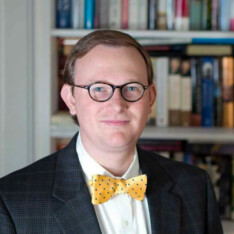
Allen Mendenhall is Associate Dean and Grady Rosier Professor in the Sorrell College of Business at Troy University.
He holds a B.A. in English from Furman Academy, M.A. in English from Westward Virginia University, J.D. from Westward Virginia University College of Law, LL.M. in transnational law from Temple Academy Beasley School of Police force, and Ph.D. in English language from Auburn University.
Source: https://www.aier.org/article/what-it-means-to-have-a-teachable-spirit/
0 Response to "What Does It Mean to Have a Teachable Spirit"
Enregistrer un commentaire